
Tempe City Directory Holdings
Tempe's directory trail is spread across the Arizona Memory Project, Tempe History Museum, Tempe Public Library, Arizona State Research Library, and subscription databases. The verified record begins with business and city books in 1903, continues through Salt River Valley volumes, and reaches later Tempe-specific household and street guides. No official source supports a complete continuous run or a final printed year, so gaps should be stated rather than filled by assumption.
| Collection | Verified years | Where held | Access |
|---|---|---|---|
| Phoenix, Tempe & Mesa business directory | 1903 | Arizona Memory Project | Free digitized volume |
| A.P. Skinner's Phoenix directory | 1903, 1905-06 | Arizona Memory Project | Digitized; check Tempe scope by page |
| Phoenix & Salt River Valley | 1912-30 selected runs | Arizona Memory Project | Free PDFs with Tempe sections |
| Mesa/Tempe/Chandler/Gilbert | 1946-47 | FamilySearch and AMP | Digitized |
| National Home / Salisbury | 1948, 1954 | Tempe Museum research library | Appointment research |
| Mullin-Kille/Baldwin | 1952, 1958, 1961, 1963 | Museum and research library | In-person research |
| Polk's Mesa-Tempe | 1968 | Tempe Museum | Alphabetical and street guide |
The State Research Library at 1901 W. Madison Street in Phoenix also holds print or microform directories, maps, newspapers dating from 1859, and vertical files. Ask library or museum staff for a physical shelf list before claiming that a year does not exist.
Access varies by keeper. Arizona Memory Project scans are free online. Tempe Public Library databases require a library computer. Museum holdings and older newspaper material require an appointment. The State Research Library supplies the broadest physical fallback for print, microform, maps, and vertical files. These channels should be used together because a title visible in a catalog may not yet have a searchable scan.
Tempe Directory Years in Context
Publisher changes track Tempe's shift from a small settlement into a valley city. Early books often embed Tempe inside a broader Phoenix or Salt River Valley work. Later publishers created stronger local household and street access. A short timeline keeps those formats distinct.
| 1903 | Digitized business and A.P. Skinner volumes begin the verified directory record. |
|---|---|
| 1912-30 | Arizona Directory Company issues Tempe-inclusive Phoenix and Salt River Valley volumes. |
| 1946-63 | Southside, National Home, Salisbury, Mullin-Kille, and Baldwin runs supply more local coverage. |
| 1968 | Polk's Mesa-Tempe book advertises a complete street and avenue guide. |
Maricopa County dates to 1871, and the Town of Tempe incorporated in 1894. Yet ASU lists a Tempe Sanborn map from 1890. That earlier building record can support a city directory address even before the municipal minutes begin.
Search Tempe Directories Online
The Arizona Memory Project provides the best open digital starting point. Its 1921 Phoenix and Salt River Valley directory explicitly includes Tempe. Large PDFs may respond better to a downloaded search than a browser viewer. Search surname variants, initials, spouse names, firms, road names, rural routes, and nearby landmarks.
OCR, or machine-read scan text, can misread narrow columns and worn type. Browse the alphabetical range even after a failed keyword search. Confirm the section header because a Phoenix householder page and a Tempe rural-route page can appear in the same book. Save the title page, publication year, page number, and exact entry.
Note: A digitized sample proves that volume exists; it does not establish a complete annual Tempe city directory run.
Tempe Directory Research Rooms
Tempe Public Library genealogy resources include Ancestry Library Edition and HeritageQuest, but both work only on library computers. Those databases include census, vital, military, immigration, cemetery, yearbook, church, organization, and city directory material. The library also routes obituary searches through subscribed news databases.
Tempe History Museum research services are available by appointment. The museum holds nearly 50,000 cataloged photos and documents, while its eMuseum catalog searches more than 70,000 objects by keyword. Useful groupings include Old Settlers, campus life, houses of worship, and neighborhood or decade collections. Previous Arizona Republic years are also available there by appointment.
Bring the person's spelling variants, likely years, address, trade, relatives, and Tempe tie. Focused questions help staff locate uncataloged folder-level material that a broad web search will miss.
The public museum catalog does not require an account for name or place searches. An account is needed only to save sets. A result may supply an object title, date, subject, collection grouping, and image or catalog description. Use those fields to form a tighter appointment request. The Old Settlers grouping contains 515 objects, houses of worship 69, and 1970s Community Development 382, giving several local paths beyond a surname-only query.
Decode a Tempe City Directory
Read the abbreviation key in the same volume before expanding any symbol. A verified OCR example, “Benton Theron E sten Peek & Fleming r Park rd and Southern av,” combines a name, abbreviated occupation, employer, residence marker, and intersection. Page context still must confirm that the entry belongs in the Tempe section.
| Name | Surname, given name or initial, and sometimes a spouse in parentheses |
|---|---|
| Role | Occupation abbreviation or employer; businesses may add a trade class |
| Residence | h for home or house, or r for resides or rooms, followed by an address |
| Context | Telephone, business address, rural route, intersection, or cross-reference |
| Status marks | Widow or owner/renter marks may occur, but were not verified in every Tempe run |
- Criss-cross directory
- A directory ordered by street and house number, often after an alphabetical section.
- Householder index
- An address-first list that links a house number to a named householder or business.
- Abbreviation key
- The volume's own legend for short forms, residence marks, trades, and cross-references.
Do not import one publisher's symbols into another publisher's book. Owner and renter marks exist in some Arizona directories, but the inspected Tempe entry did not verify them for every year.
Tempe Rural Routes Versus Streets
The 1925 volume contains alphabetical private-citizen and business listings, a classified business section, and separate Tempe rural-route pages. Its street and householder guide is for Phoenix. Calling that guide a Tempe criss-cross would create false address evidence.
By 1968, Polk explicitly describes a complete street and avenue guide for household and business-space occupants. This is a real change in search mode. A name-first entry answers who appears in the book. An address-first guide answers what the publisher printed at a site. Both remain dated secondary records and need support from deeds, census schedules, obituaries, or maps.
Map Tempe Directory Addresses
City directories identify people, while fire-insurance maps identify structures. ASU's Tempe Sanborn index lists editions for 1890, 1893, 1898, 1901, 1911, 1915, 1927, 1941, and 1948. The Library of Congress 1915 Tempe map is a free seven-sheet set.
The successful manifest image below captures ASU's Tempe map-holdings page.
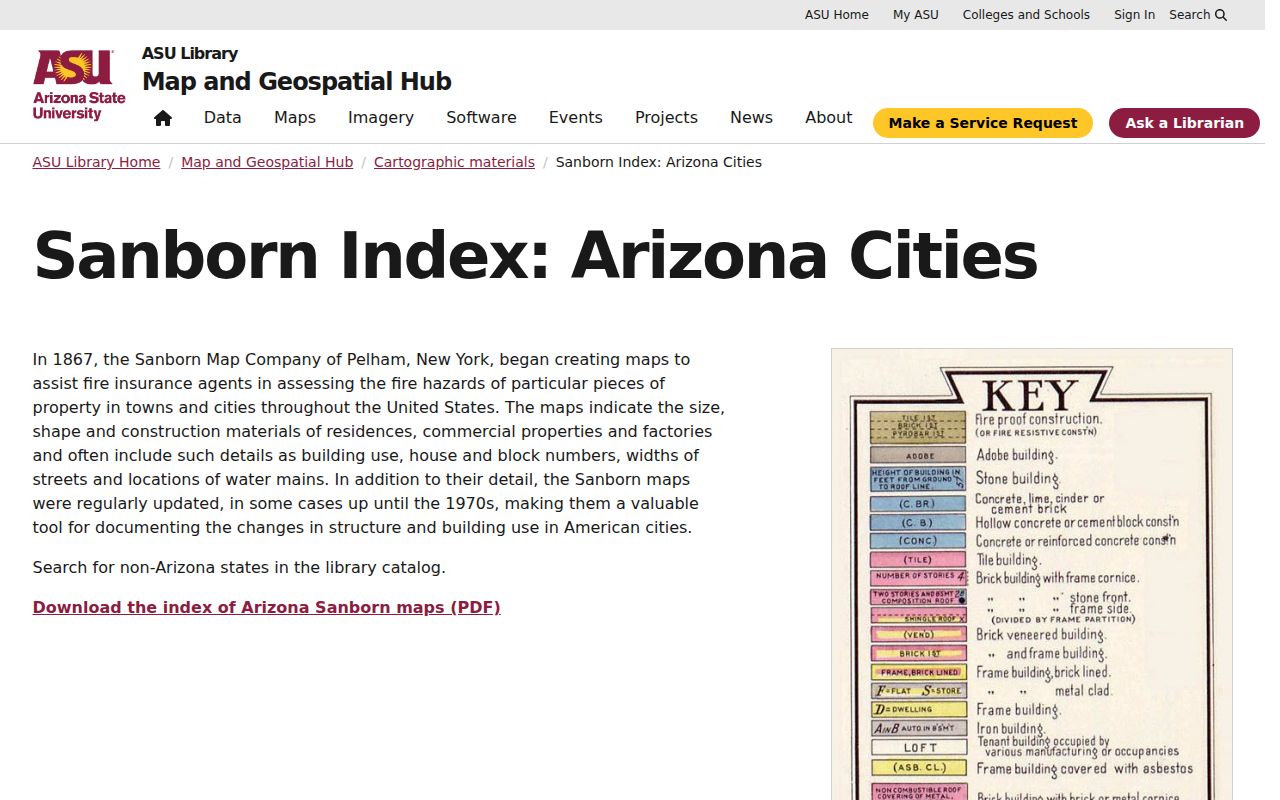
Match a directory address to a footprint, street label, lot position, and nearby landmark. When the number changed, use the parcel legal description, plat, historic property name, and building shape rather than guessing a citywide renumbering date.
Trace Families in Tempe Directories
A city directory can fill the years between federal census schedules, which are public through 1950 under the 72-year rule. Follow the household across adjacent books and note every spelling, spouse, occupation, employer, address, and route. Then test the pattern against a census household rather than relying on a same-name match.
- Find the earliest likely name entry and record its page, section, spelling, and all short forms.
- Compare the next available directory, noting moves, spouse changes, trades, employers, and disappearance.
- Use an address-ordered section only when that Tempe volume actually provides one.
- Pair the directory sequence with the 1910, 1920, 1930, 1940, or 1950 census household.
- Close gaps with obituary databases, museum newspapers, maps, yearbooks, church material, and property records.
Disappearance can mean death, a move, omission, a spelling change, or a switch to an unlisted household. It is not proof by itself. An obituary may establish death or kin; a deed may show a transfer; the next census or directory may reveal a move. For modern address-keyed parcel and permit work, use the Tempe street directory workflow instead of stretching historical print beyond its date.
Tempe Records Beyond Directories
There is no official evidence that a courthouse fire destroyed Tempe or Maricopa County record groups. The documented archive story is different. A 1978 State Archives report describes rescuing eleven reels of Maricopa water-history Superior Court records dating to 1918 from courthouse recesses and indexing them.
That episode shows why catalog and reference requests still matter. Tempe History Museum's public eMuseum can lead from a family, church, or place name into photos, oral histories, and local files. Arizona State Archives' biographical database indexes people found in books, newspapers, obituaries, periodicals, and vertical files, but the agency does not call it complete. A focused request may reach material that has not been described item by item online.
School yearbooks and church or organization directories can also bridge a missing city directory year. ASU affiliation records need a location check because campus mail uses the institutional 85287 ZIP and PO Box 87XXXX routing. That code can describe campus delivery rather than a conventional home. Record the source type and date so an institutional address is not silently recast as a household address.
Note: Search variants and affiliations as well as names; Tempe's multilingual, campus, farm, barrio, church, and neighborhood histories create many paths into a collection.