
Tempe Previous Residents by Era
A backward address search works best when the source matches the period. The Maricopa County Assessor establishes the present parcel and points to its deed. The Recorder supplies the ownership chain, while Tempe directory, census, map, and planning sources add households and building context. The county does not state the earliest year of its traditional online grantor and grantee index, so no honest Tempe previous residents search should promise a firm web cutoff.
| Source | Years It Covers | Where Held | What It Shows |
|---|---|---|---|
| Recorder traditional index | Earliest online year not stated | Maricopa County Recorder and counter | Ownership chain and recorded instruments |
| Recorder full-text address search | Latest two years | Recorder online | Recent names, addresses, and legal descriptions |
| Tempe directories | Samples from 1903 forward; 1968 street guide | Arizona Memory Project, Museum, State Library | Dated residents, businesses, and later address-to-name entries |
| Federal census | 1910 through 1950 public locally | NARA and library databases | Households at ten-year intervals |
| Sanborn maps | 1890 through 1927; 1941 and 1948 cataloged | ASU, Library of Congress, databases | Footprints, use, materials, and old street context |
| Historic property files | 1980-83 survey and later work | Tempe Museum and preservation office | Construction, owners, occupants, and former addresses |
For a recent transfer, begin online. For a mid-century household, pair the deed with the 1968 Polk street guide and a census year. For an older building, expect staff help, map work, and print or microform sources. These layers separate title history from the more difficult question of who lived there.
Anchor a Tempe Resident Address
Street text can change while land stays put. Search the Maricopa County Assessor by standardized address, full owner name, or assessor parcel number, known as an APN. Save the APN, indexed owner, situs address, mailing address, deed number, subdivision, and MCR reference. Situs means the physical property address. A mailing address is where tax notices go, and it may belong to an owner who lives elsewhere.
The APN and legal description are stronger continuity keys than a street label. A legal description identifies land through a subdivision, lot, block, or other formal survey terms. Open the deed link and compare that description at every step. Matching names alone is unsafe, especially when an owner has a common name or title rests in a trust. The assessor also offers parcel-history reports by email at asr.pa@maricopa.gov when the public card lacks older context.
Note: An assessor owner is not proof of occupancy, and a different mailing address never identifies renters or other household members.
Walk Tempe Deed Records Backward
The Maricopa County Recorded Document Search links each conveyance to the next. It reports a collection of more than 52 million documents, including deeds, deeds of trust, releases, liens, plats, covenants, judgments, and affidavits. Search and unofficial images are free. Official copies cost $1 per page, and certification adds $3 per document. The index itself does not prove that a parcel is free of liens.
- Open the current assessor deed and record its buyer, seller, date, document number, and exact legal description.
- Search the seller as an earlier grantee, meaning the buyer in a prior transfer. Limit results to dates before the current sale.
- Confirm the same subdivision, lot, block, or legal description before accepting a deed as part of the chain.
- Repeat seller to earlier grantee. Search a trust or company under Business Name rather than forcing it into a person field.
- When online clues stop, use Recorder staff, the Phoenix counter, book and page references, microfilm, title references, and archive catalogs.
- Grantor and grantee
- The grantor transfers an interest; the grantee receives it.
- Chain of title
- The linked sequence of recorded transfers for the same land.
- Legal description
- The formal land identity used to test whether two records concern the same parcel.
The same seller can appear in several unrelated filings. Dates narrow the field, but the legal description decides whether the instrument belongs in this address trail. Preserve rejected candidates as notes rather than forcing them into the chain.
Tempe Resident Address Shortcut
The Recorder's Research mode is useful but narrow. Its full-text engine searches names, legal descriptions, and addresses only within the latest two years. Quoted phrases, OR, and thesaurus matching can catch recent wording variants. That convenience does not reach the full historical index. Older ownership research must move through party names, document numbers, dates, book and page references, plats, and legal descriptions.
This is a valuable Tempe quirk. A blank address result may mean only that the transfer predates the modern search window. It does not mean the deed is missing. Try the current deed number from the assessor, then search the grantor and grantee. Partial subdivision names may help with plats, while covenants often sit under the subdivision or association business name. Call the Recorder at 602-506-3535 before stating any earliest online year.
When Tempe Address Records Shift
Official Tempe property research documents address changes without supporting one universal renumbering date. One property at 221 E Sixth was formerly 6 W Fifth. Another at 2029 E Apache was formerly 710 S Ash. These examples prove that an exact old string can fail even when the same structure or parcel remains. Tempe previous residents research must test continuity, not assume a citywide rule.
Bridge an old and new address with the APN, parcel legal description, subdivision plat, historic property name, and building footprint. A Sanborn map can show the footprint and use at the earlier address. A directory can then attach a dated name. This method also handles demolition and redevelopment. Tempe's 1980-83 survey documented 158 significant properties, and the city later reported that only about 60 percent of the most important buildings studied in 1983 remained.
Note: A correct Tempe directory entry may point to a parcel whose original building no longer survives at the recorded address.
Map Tempe Resident History
Tempe Sanborn coverage begins in 1890, before the town's 1894 incorporation. Editions are listed for 1890, 1893, 1898, 1901, 1911, 1915, and 1927, with later 1941 and 1948 holdings also cataloged. These fire-insurance maps describe buildings, footprints, use, and materials. They do not name every person, but they can confirm whether a structure existed and show how an old address fit its block.
The ASU Sanborn map index identifies the Tempe editions, while the Library of Congress provides the seven-sheet May 1915 Tempe map free. Pair the correct sheet with a directory year or census schedule. That map-to-name combination can take a past residents trail earlier than municipal files alone.
Tempe Property Records Fill Gaps
Building records date changes to the property, not necessarily the people who lived there. The Tempe Accela portal searches by address, parcel, record, project, professional, and date. Planning entries before April 2015 may be incomplete. A named contact or contractor shows a project role, never residence, but permits can explain an addition, demolition, unit change, or use shift between directory years.
When the portal fails, request property cards, address histories, inspection files, certificates of occupancy, and planning records through Tempe Community Development. Its stated average is twenty business days, with online, kiosk, mail, and counter channels. The city did not retain single-family residential plans before electronic submission began in 2020; older plans were discarded one year after final inspection. A missing plan is therefore not proof that no work occurred.
Pair Tempe Directories and Census
Owners are only part of the past residents story. A dated directory or census can reveal occupants who never held title. The verified 1968 Polk Mesa-Tempe volume includes a street and avenue guide for household and business-space occupants. The 1925 Tempe section instead uses rural routes; its householder street guide covers Phoenix and must not be applied to Tempe. The detailed collection history belongs on the Tempe city directory page.
- Find the address or parcel in the closest verified directory year and copy every name, spelling, residence mark, and cross-reference.
- Check the adjacent directory years for arrivals, departures, spouse changes, and shifts in the address line.
- Pair the result with a public 1910, 1920, 1930, 1940, or 1950 census household where the place and timeline fit.
- Use the parcel, plat, or Sanborn footprint to bridge a rural route or former number rather than guessing.
- Record source and year beside each name so a dated occupant is not mistaken for a current resident.
Tempe Public Library offers Ancestry Library Edition and HeritageQuest only on library computers. The Museum provides appointment research, while Arizona Memory Project supplies digitized directories. The federal census uses a 72-year release rule and is public through 1950.
Close a Tempe Resident Trail
Probate, obituaries, and death records can explain why a person disappears from a deed or directory. Search the Maricopa Superior Court probate docket and obtain the file through the Clerk when needed. A probate record may identify a decedent, representative, or heirs, but it does not replace the recorded deed as title proof. Tempe Public Library provides obituary routes, and earlier Arizona Republic research is available at Tempe History Museum by appointment.
For an eligible historical record, Arizona opens births 75 years after birth and deaths 50 years after death. The image on the genealogy portal is not a certified copy. Current certified records remain limited to eligible applicants. The Maricopa County birth and death ordering page shows the official request route.
The county ordering screen below helps distinguish a custodian request from a public index search.
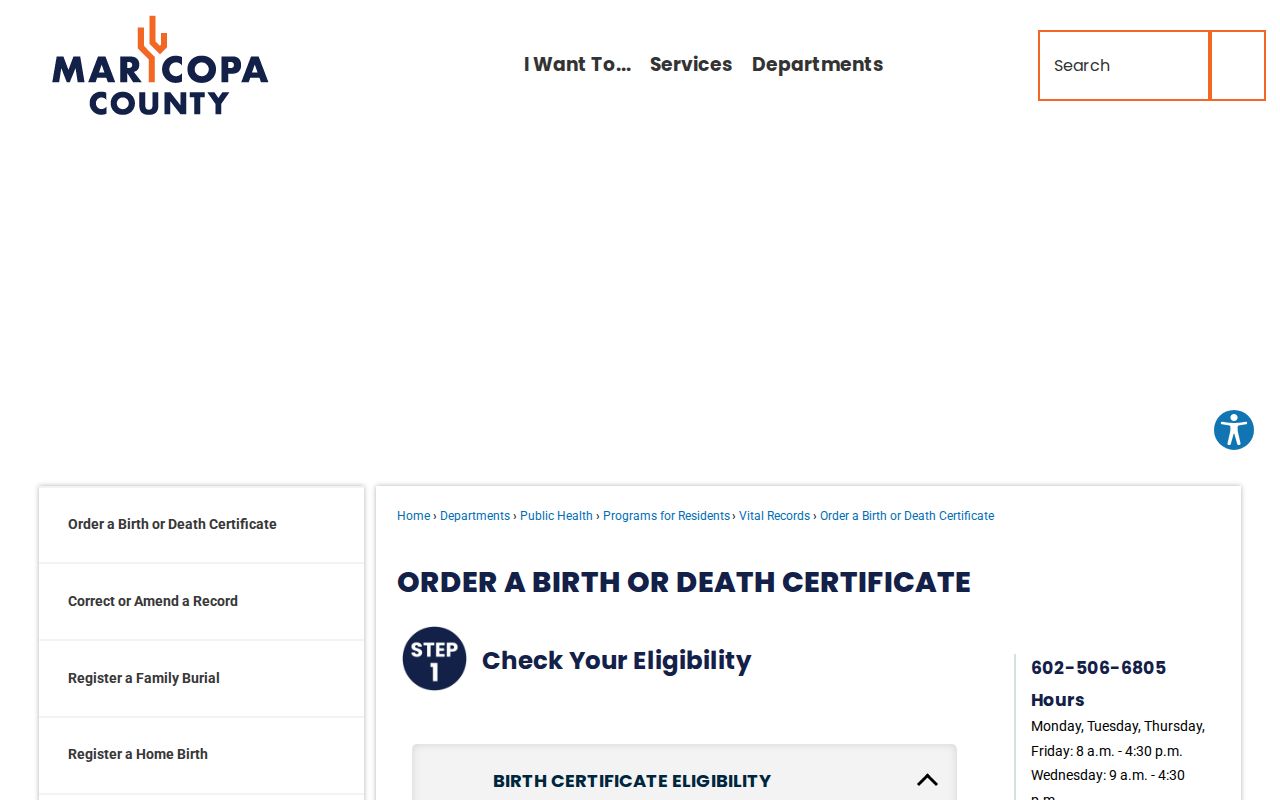
The form route is useful only when the requester meets the record rules. It should not be read as open access to every certificate or application field.
Protect a Tempe Property Name
A backward chain can expose a suspicious transfer. The Arizona Attorney General's 2025 lawsuit alleged that vulnerable owners were pushed to transfer deeds into shell trusts and entities. Independently verify any unexpected instrument with the Recorder and a known contact channel. The Maricopa County Title Alert is free, supports unlimited monitored names, and reports more than 92,900 accounts.
Title Alert sends an email or text after a new matching document is recorded. It does not stop fraud and covers post-signup recordings. Add hyphenated and separate surname variants when relevant. An alert is a cue to inspect the document, not proof that the filing is wrongful.
Use Tempe Past Residents Lawfully
Previous residents work is strongest when every claim is dated and sourced. Deeds identify parties to an instrument. Directories identify people in one published year. Census records show a household on an enumeration date. Permits name project roles. None of those sources should be stretched into a claim about where a living person is now. Arizona's Address Confidentiality Program supplies a substitute address for eligible survivors and keeps routine records from exposing the protected home.
If a record is absent online, use the documented fallback: assessor history by email, Recorder staff and counter, Tempe Community Development request channels, Museum appointment research, State Library print or microform, and Clerk court-copy procedures. Narrow requests by address, APN, record type, and date range. Arizona Public Records Law calls for prompt access to open existing records, but an office need not create a new household list.
Lawful use. Tempe previous residents research supports house history, family history, and estate work. Never use an address trail to stalk, harass, intimidate, or harm anyone.